Docs › Examples › Split-and-recombine micromixer at five flow rates
Microfluidics · 3D
Split-and-recombine micromixer at five flow rates
The same split-and-recombine micromixer run as a batch of five flow rates, from Re = 0.15 to 2 and Péclet numbers 15 to 200.
Run locally with OneSimulation. The example downloads are free. Running them requires an activated runtime. OneSimulation 1.0 · CPython 3.13 on macOS (Apple Silicon), Ubuntu 22.04 (x86-64), and Windows x64. Installation and activation · View pilot plans. Scope of the reference checks.
What it computes
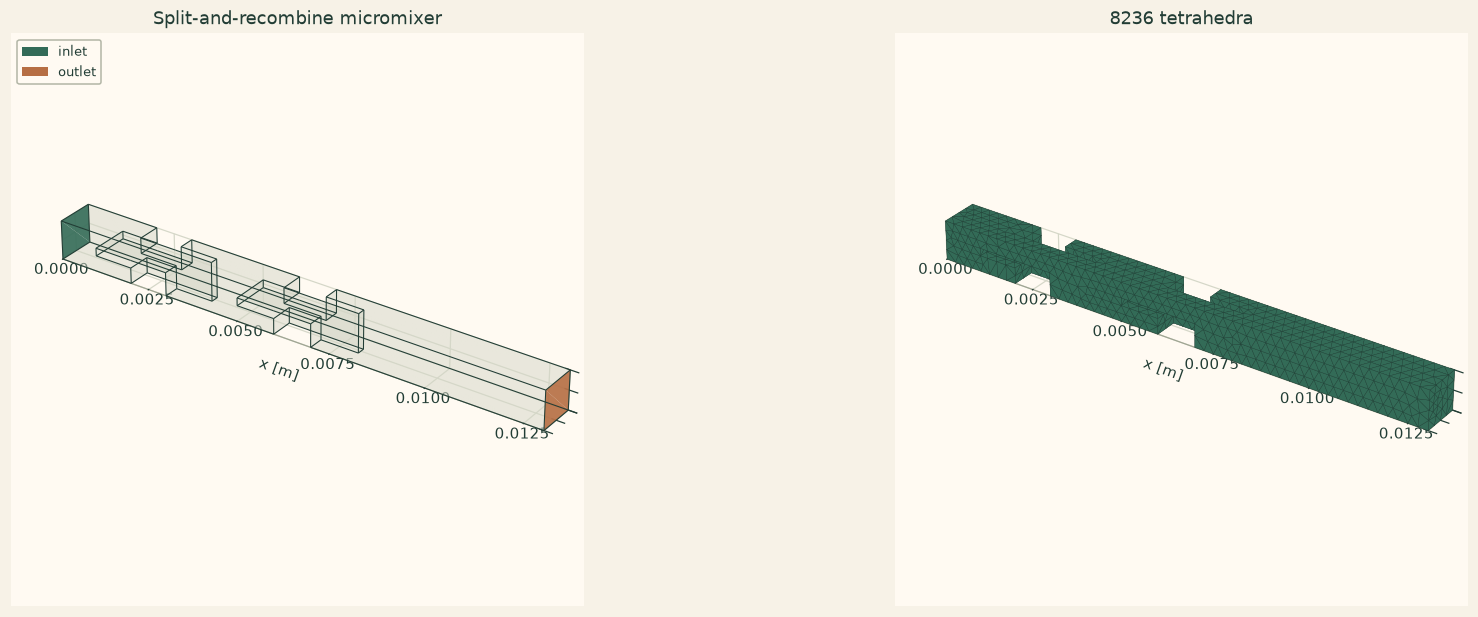
The mixer is read from a STEP file and meshed with tetrahedra. For each flow rate OneSimulation solves the 3D flow with Taylor-Hood elements and the solute in it with quadratic elements, and evaluates the pressure drop and the mixing index in the outlet duct. The script that builds the STEP file comes with the notebook.
What it checks
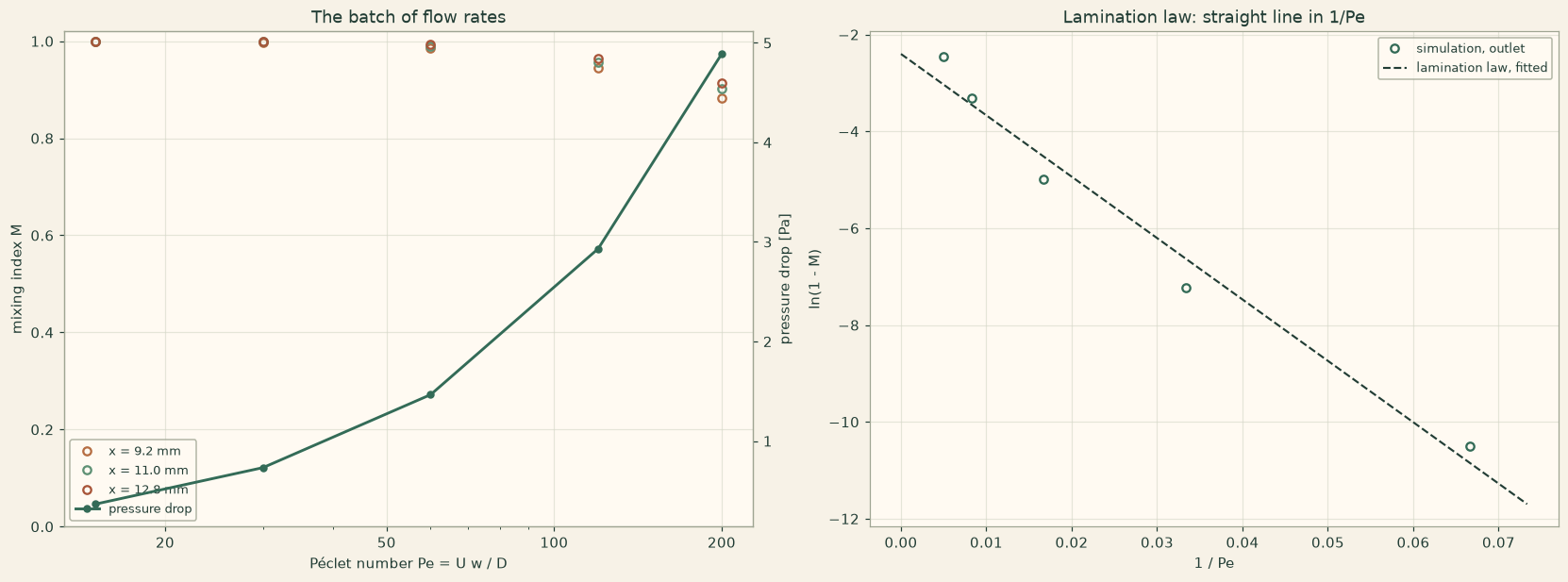
The pressure drop per flow rate is constant within 5e-4 over the batch (creeping flow); the outlet mixing index falls from 1.000 to 0.914 as the Péclet number rises from 15 to 200, and the lamination law ln(1-M) linear in 1/Pe describes the trend (fitted 0.969 and 0.952 at Pe = 120 and 200 against computed 0.964 and 0.914).
Geometry
The notebook starts at the import of the CAD file split_recombine_micromixer_flow_rates.step: STEP (AP242), readable by any CAD program, with the names of the faces that the boundary conditions use. Put it next to the notebook.
The geometry script
The script split_recombine_micromixer_flow_rates_geometry.py builds the geometry with the CAD objects of OneSimulation and writes the file. Change a dimension there, run it, and run the notebook again.
"""Geometry of the OneSimulation example "Split-and-recombine micromixer at five flow rates".

Builds a micromixer of square channels 1 mm wide with two split-and-recombine elements with the CAD
objects of OneSimulation, as a straight square channel from which the dividing walls are cut out.
In each element the stream is cut into an upper and a lower half; the upper half is squeezed into
the left half of the channel and the lower half into the right half, both are stretched back to the
full height, and the two halves are joined side by side again, so that the number of layers
doubles. Walls 0.2 mm thick separate the branches. The part is written to
split_recombine_micromixer_flow_rates.step with the face groups inlet (x = 0) and outlet (x = 13 mm).
"""

from onesim.cad.d3 import Box

mm = 1e-3
side, wall, elements = 1.0 * mm, 0.2 * mm, 2
length = (5 + 4 * elements) * mm
low, high = (side - wall) / 2, (side + wall) / 2
box = lambda x0, x1, y0, y1, z0, z1: Box(
    length=x1 - x0, width=y1 - y0, height=z1 - z0, origin=(x0, y0, z0)
)
mixer = box(0, length, 0, side, 0, side)
for start in [(1 + 4 * k) * mm for k in range(elements)]:
    mixer = (
        mixer
        - box(start, start + mm, -side, 2 * side, low, high)
        - box(start + mm, start + 2 * mm, low, 2 * side, low, 2 * side)
        - box(start + mm, start + 2 * mm, -side, high, -side, high)
        - box(start + 2 * mm, start + 3 * mm, low, high, -side, 2 * side)
    )
mixer = mixer.grouped(
    inlet=mixer.select(faces=lambda face: abs(face.center[0]) < 1e-9),
    outlet=mixer.select(faces=lambda face: abs(face.center[0] - length) < 1e-9),
)
mixer.save("split_recombine_micromixer_flow_rates.step")
The notebook
The complete notebook, cell by cell. Run it to produce the figures and the comparison printout.
A micromixer is designed for a range of flow rates, not for one, and the design study runs the same model as a batch over that range. In a split-and-recombine mixer the layers that leave the last element have a thickness \(s\) set by the geometry; the faster the flow, the less time diffusion has to bridge them. With the residence time \(t\propto 1/\bar U\) the unmixed fraction decays as \(e^{-\pi^2Dt/s^2}\), so its logarithm falls linearly with \(1/\bar U\), that is with the inverse Péclet number \(1/Pe=D/(\bar Uw)\) (lamination law; V. Hessel, H. Löwe, F. Schönfeld, Chem. Eng. Sci. 60, 2479-2501, 2005). In creeping flow the pressure drop grows in proportion to the flow rate.
The mixer comes from the CAD file split_recombine_micromixer_flow_rates.step, written by split_recombine_micromixer_flow_rates_geometry.py: square channels of side \(w=1\) mm with two split-and-recombine elements and a straight outlet section of 4 mm. Water with a solute of diffusivity \(D=10^{-8}\) m²/s enters at mean speeds from 0.15 to 2 mm/s (\(Re\) from 0.15 to 2, \(Pe\) from 15 to 200).
| face | flow | solute |
|---|---|---|
inlet | fully developed duct profile, mean speed \(\bar U\) | \(c=\tfrac12\left(1+\tanh((w/2-y)/0.05\,\text{mm})\right)\) |
outlet | traction free | no diffusive flux |
| all walls | no slip | no flux |
Reference. Creeping flow: \(\Delta p\propto\bar U\). Lamination law: in the outlet section \(\ln(1-M)\), with the mixing index \(M\), falls linearly with \(1/Pe\).
import numpy as np
from onesim.cad.exchange import load
from onesim.materials import IsotropicSolid, NewtonianFluid
from onesim.meshing import TetrahedralMesher
from onesim.numerics import Numerics
from onesim.numerics.fem import FiniteElement, GalerkinAdvection, Lagrange, TaylorHood
from onesim.numerics.linear import SparseDirect
from onesim.numerics.nonlinear import Newton
from onesim.physics.heat_transfer import (
    ConvectiveHeatTransfer,
    FixedTemperature,
    HeatFlux,
)
from onesim.physics.hydrodynamics import (
    FixedVelocity,
    FlowTraction,
    IncompressibleNavierStokes,
    NoSlipWall,
    fully_developed_inflow,
)
from onesim.results.sampling import field_function
from onesim.simulation import Problem, Simulation
from onesim.visualization import plots, theme

theme.set()
Geometry and mesh
Tetrahedra of 0.25 mm; split_boundary_cells divides the cells whose corners all lie on walls.
mm = 1e-3
mixer = load("split_recombine_micromixer_flow_rates.step")
faces = mixer.boundaries
walls = faces.all - faces.inlet - faces.outlet
side = mixer.size[1]
mesh = TetrahedralMesher(target_size=0.25 * mm, split_boundary_cells=True).generate(
    mixer
)

view = plots.Camera(elevation=30, azimuth=-55)
fig = plots.figure(1, 2, size=(16, 5.5))
plots.geometry(
    mixer,
    selection={"inlet": faces.inlet, "outlet": faces.outlet},
    labels=False,
    camera=view,
    title="Split-and-recombine micromixer",
    ax=fig[0],
)
plots.mesh(
    mesh,
    groups=("all",),
    legend=False,
    camera=view,
    title=f"{mesh.cell_count} tetrahedra",
    ax=fig[1],
)
plots.show()
The batch of flow rates
For each mean speed one flow problem and one solute problem in its flow.
water, diffusivity = NewtonianFluid(density=1000.0, dynamic_viscosity=1.0e-3), 1e-8
solute = IsotropicSolid(
    density=1.0,
    specific_heat_capacity=1.0,
    thermal_conductivity=diffusivity,
    youngs_modulus=1.0,
    poisson_ratio=0.3,
    thermal_expansion_coefficient=0.0,
)
speeds = (0.15e-3, 0.3e-3, 0.6e-3, 1.2e-3, 2e-3)
runs = {}
for speed in speeds:
    flow = IncompressibleNavierStokes(domain=mixer.volume, material=water)
    problem = Problem(
        name="SAR mixer batch: flow",
        geometry=mixer,
        physics=(flow,),
        boundary_conditions=(
            FixedVelocity(
                boundary=faces.inlet,
                physics=flow,
                value=fully_developed_inflow(
                    mesh, faces.inlet, mean_velocity=speed, no_slip=walls
                ),
            ),
            FlowTraction(boundary=faces.outlet, physics=flow, value=(0.0, 0.0, 0.0)),
            NoSlipWall(boundary=walls, physics=flow),
        ),
    )
    numerics = Numerics(
        spatial=FiniteElement(element=TaylorHood()),
        initial_guess={flow.velocity: (0.0, 0.0, 0.0)},
        nonlinear_solver=Newton(
            linear_solver=SparseDirect(),
            absolute_tolerance=1e-20,
            relative_tolerance=1e-9,
        ),
    )
    solved = Simulation(
        problem=problem, mesh=mesh, numerics=numerics
    ).solve_stationary()
    velocity = solved.field(flow.velocity)
    transport = ConvectiveHeatTransfer(
        domain=mixer.volume, material=solute, velocity=field_function(velocity)
    )
    problem = Problem(
        name="SAR mixer batch: solute",
        geometry=mixer,
        physics=(transport,),
        boundary_conditions=(
            FixedTemperature(
                physics=transport,
                boundary=faces.inlet,
                value=lambda y: 0.5 * (1 + np.tanh((side / 2 - y) / (0.05 * mm))),
            ),
            HeatFlux(physics=transport, boundary=faces.all - faces.inlet, value=0.0),
        ),
    )
    numerics = Numerics(
        spatial=FiniteElement(
            element=Lagrange(order=2), convection=GalerkinAdvection()
        ),
        linear_solver=SparseDirect(),
    )
    runs[speed] = (
        velocity,
        solved.field(flow.pressure),
        Simulation(problem=problem, mesh=mesh, numerics=numerics)
        .solve_stationary()
        .field(transport.temperature),
    )
Results
Pressures and the flow-weighted mixing index \(M=1-\sigma/\sigma_0\) on cross-sections of the straight inlet and outlet sections.
grid_y, grid_z = np.meshgrid(
    np.linspace(0.04, 0.96, 24) * side, np.linspace(0.04, 0.96, 24) * side
)
section = lambda x: np.column_stack(
    (np.full(grid_y.size, x), grid_y.ravel(), grid_z.ravel())
)
sample = lambda run, x: (
    np.ravel(run[2].evaluate(section(x))),
    run[0].evaluate(section(x))[:, 0],
)
deviation = lambda values, weights: np.sqrt(
    np.average((values - np.average(values, weights=weights)) ** 2, weights=weights)
)
stations = (9.2 * mm, 11 * mm, 12.8 * mm)
mixing = {
    speed: np.array(
        [
            1 - deviation(*sample(run, x)) / deviation(*sample(run, 0.5 * mm))
            for x in stations
        ]
    )
    for speed, run in runs.items()
}
drops = {
    speed: np.mean(run[1].evaluate(section(0.5 * mm)))
    - np.mean(run[1].evaluate(section(12.8 * mm)))
    for speed, run in runs.items()
}
peclet = {speed: speed * side / diffusivity for speed in speeds}
slope, offset = np.polyfit(
    [1 / peclet[s] for s in speeds], [np.log(1 - mixing[s][-1]) for s in speeds], 1
)
fitted = {s: 1 - np.exp(offset + slope / peclet[s]) for s in speeds}

print(
    " U [mm/s]   Re     Pe    Δp [Pa]   (Δp/U) / (Δp/U at the lowest speed)   mixing index at x = 9.2, 11, 12.8 mm   lamination law"
)
for speed in speeds:
    print(
        f"{1e3 * speed:8.2f} {water.density * speed * side / water.dynamic_viscosity:5.2f} {peclet[speed]:6.0f} {drops[speed]:9.4f}"
        f" {drops[speed] / speed / (drops[speeds[0]] / speeds[0]):22.4f}            "
        + "  ".join(f"{m:.4f}" for m in mixing[speed])
        + f" {fitted[speed]:14.4f}"
    )
print(
    f"\nlamination law fitted to all five runs: ln(1 - M) = {offset:.3f} {slope:+.2f} / Pe"
)
Figure
Outlet mixing and pressure drop over the Péclet number, and the lamination-law plot.
inverse = np.linspace(0.0, 1.1 / peclet[speeds[0]], 50)
fig = plots.figure(1, 2, size=(15, 5.5))
plots.line(
    points={
        f"x = {x / mm:.1f} mm": (
            [peclet[s] for s in speeds],
            [mixing[s][index] for s in speeds],
        )
        for index, x in enumerate(stations)
    },
    right={"pressure drop": ([peclet[s] for s in speeds], [drops[s] for s in speeds])},
    right_label="pressure drop [Pa]",
    scale="logx",
    markers=True,
    ylimits=(0.0, 1.02),
    xlabel="Péclet number Pe = U w / D",
    ylabel="mixing index M",
    title="The batch of flow rates",
    legend="lower left",
    ax=fig[0],
)
plots.line(
    points={
        "simulation, outlet": (
            [1 / peclet[s] for s in speeds],
            [np.log(1 - mixing[s][-1]) for s in speeds],
        )
    },
    reference={"lamination law, fitted": (inverse, offset + slope * inverse)},
    xlabel="1 / Pe",
    ylabel="ln(1 - M)",
    title="Lamination law: straight line in 1/Pe",
    legend="upper right",
    ax=fig[1],
)
plots.show()
Going further
Add a third element in split_recombine_micromixer_flow_rates_geometry.py: the layer thickness halves and the slope of the lamination law grows about fourfold, so the same mixing is reached at four times the flow rate.