Docs › Examples › Tubular steam reformer geometry
CAD geometry · 3D
Tubular steam reformer geometry
Nineteen catalyst tubes on two rings in a cylindrical shell with inlet and outlet plenums, built as catalyst beds and shell space.
Run locally with OneSimulation. The example downloads are free. Running them requires an activated runtime. OneSimulation 1.0 · CPython 3.13 on macOS (Apple Silicon), Ubuntu 22.04 (x86-64), and Windows x64. Installation and activation · View pilot plans. Scope of the reference checks.
What it computes
OneSimulation places the tubes by rotating one tube about the axis, subtracts all of them from the shell and joins shell space and tubes in an assembly that is meshed as one with a volume per part and the tube walls as contact faces.
What it checks
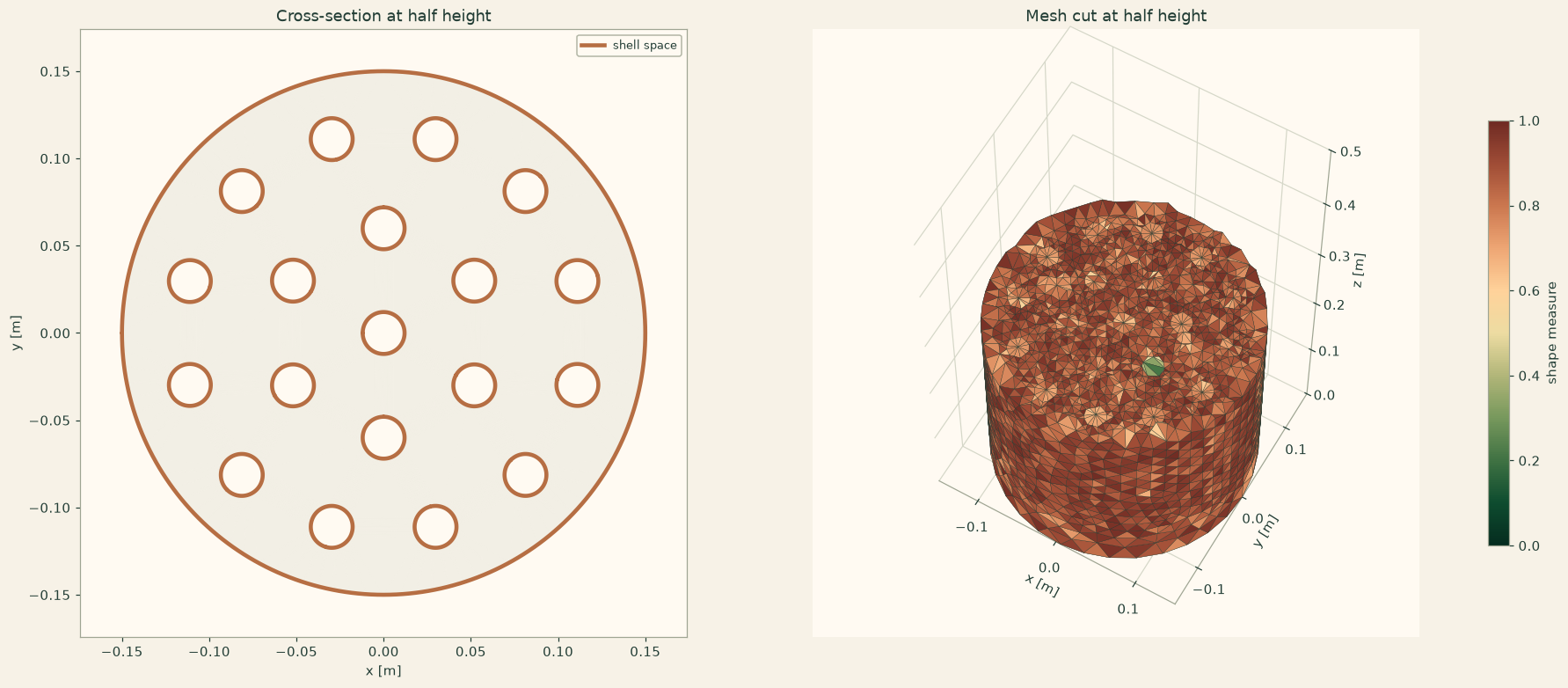
Shell-space and tube volumes (31.905 and 3.438 l), the heat-transfer area of the 19 contacts (0.590217 m2) and the cross-section through the bundle (620.904 cm2) equal their closed forms to all printed digits; the mesh of 296,303 tetrahedra holds the shell space within 0.2 % and the tubes within 4 % (chords of the thin tubes).
The notebook
The complete notebook, cell by cell. Run it to produce the figures and the comparison printout.
In a tubular steam reformer methane and steam react in tubes filled with catalyst while hot flue gas flows around the tubes in the shell and supplies the heat of the endothermic reaction. A model needs two kinds of domains: the catalyst beds inside the tubes and the shell space around them, with the tube walls as the faces through which the heat passes.
| part | built from | count |
|---|---|---|
tube_0 ... tube_18 | Cylinder, 24 mm diameter, 0.4 m long; centre tube, ring of 6 at 60 mm, ring of 12 at 115 mm | 19 |
shell | Cylinder of 300 mm diameter and 0.5 m height less all tubes, with 50 mm plenums above and below the tubes | 1 |
The positions of a ring come from rotating one tube about the axis (rotated); the shell space is the shell cylinder with every tube subtracted.
Reference. With shell radius \(R_s\) and height \(H_s = H + 2p\), tube radius \(r\), length \(H\) and \(N\) tubes: \(V_\text{tubes} = N\pi r^2 H\), \(V_\text{shell} = \pi R_s^2 H_s - N\pi r^2 H\), the heat-transfer area over walls and tube ends is \(A = N(2\pi r H + 2\pi r^2)\), and a cross-section through the tubes has \(\pi(R_s^2 - N r^2)\).
from functools import reduce

import numpy as np
from onesim.cad.d3 import Assembly, Cylinder
from onesim.meshing import TetrahedralMesher
from onesim.meshing.quality import quality
from onesim.visualization import plots, theme

theme.set()
Tubes and shell
A tube on the x axis at the ring radius, turned to its place on the ring.
shell_radius, tube_radius, height, plenum = 0.15, 0.012, 0.4, 0.05
rings = ((0.0, 1), (0.06, 6), (0.115, 12))
tubes = [
    Cylinder(radius=tube_radius, length=height, origin=(ring, 0.0, plenum)).rotated(
        (0, 0, 1), 2 * np.pi * k / count + np.pi / count
    )
    for ring, count in rings
    for k in range(count)
]
tubes = [tube.named(f"tube_{index}") for index, tube in enumerate(tubes)]
shell = reduce(
    lambda body, tube: body - tube,
    tubes,
    Cylinder(radius=shell_radius, length=height + 2 * plenum),
).named("shell")
reformer = Assembly(parts=[shell, *tubes])
print(f"{len(tubes)} tubes; shell space: {len(shell.faces)} faces")

mesh = TetrahedralMesher(
    target_size=0.03, curvature_angle=0.5, max_candidate_cells=400_000
).generate(reformer)
view = plots.Camera(elevation=30, azimuth=-60)
fig = plots.figure(1, 2, size=(16, 8))
plots.render(
    tubes,
    camera=view,
    material="steel",
    shadows=False,
    title="Steam reformer: the 19 catalyst tubes",
    ax=fig[0],
)
plots.mesh(
    mesh,
    cell_values=quality(mesh)["shape"],
    limits=(0, 1),
    plane=((0.0, 0.0, plenum + height / 2), (1.0, 0.0, 0.0)),
    label="shape measure",
    camera=plots.Camera(elevation=10, azimuth=0),
    title=f"Cut through three tubes: {mesh.cell_count} cells",
    ax=fig[1],
)
plots.show()
Results
Volumes of the shell space and the tubes in the CAD model and the mesh, the contact area between them, and the area of an end face of the shell space.
count = len(tubes)
cells = quality(mesh)["size"]
meshed = {
    part.id: cells[list(mesh.region_cells(reformer.volume_of(part.id)))].sum()
    for part in reformer.volumes
}
print(
    f"shell space: CAD {shell.measure * 1e3:.5f} l, mesh {meshed['shell'] * 1e3:.5f} l, "
    f"closed form {(np.pi * shell_radius**2 * (height + 2 * plenum) - count * np.pi * tube_radius**2 * height) * 1e3:.5f} l"
)
print(
    f"tubes:       CAD {sum(tube.measure for tube in tubes) * 1e3:.5f} l, mesh {sum(meshed[tube.name] for tube in tubes) * 1e3:.5f} l, "
    f"closed form {count * np.pi * tube_radius**2 * height * 1e3:.5f} l"
)
print(
    f"heat-transfer area: {sum(contact.area for contact in reformer.interfaces):.6f} m2 in {len(reformer.interfaces)} contacts, "
    f"closed form N (2 pi r H + 2 pi r^2) {count * (2 * np.pi * tube_radius * height + 2 * np.pi * tube_radius**2):.6f} m2"
)
section = shell.section((0, 0, 1), (0.0, 0.0, plenum + height / 2))
print(
    f"cross-section of the shell space: {section.measure * 1e4:.4f} cm2, closed form {np.pi * (shell_radius**2 - count * tube_radius**2) * 1e4:.4f} cm2"
)
Figure
The cross-section of the shell space with the nineteen tube openings, and the mesh cut across the tubes at half height.
fig = plots.figure(1, 2, size=(16, 7))
plots.geometry(
    section,
    selection={"shell space": section.boundaries.all},
    labels=False,
    title="Cross-section at half height",
    ax=fig[0],
)
plots.mesh(
    mesh,
    cell_values=quality(mesh)["shape"],
    limits=(0, 1),
    plane=((0.0, 0.0, plenum + height / 2), (0.0, 0.0, 1.0)),
    label="shape measure",
    camera=plots.Camera(elevation=60, azimuth=-60),
    title="Mesh cut at half height",
    ax=fig[1],
)
plots.show()
Going further
Add baffles as thin discs subtracted from the shell, give the tube walls their own thickness with AnnularCylinder, or solve the heat flow from the hot shell space into the catalyst beds.